
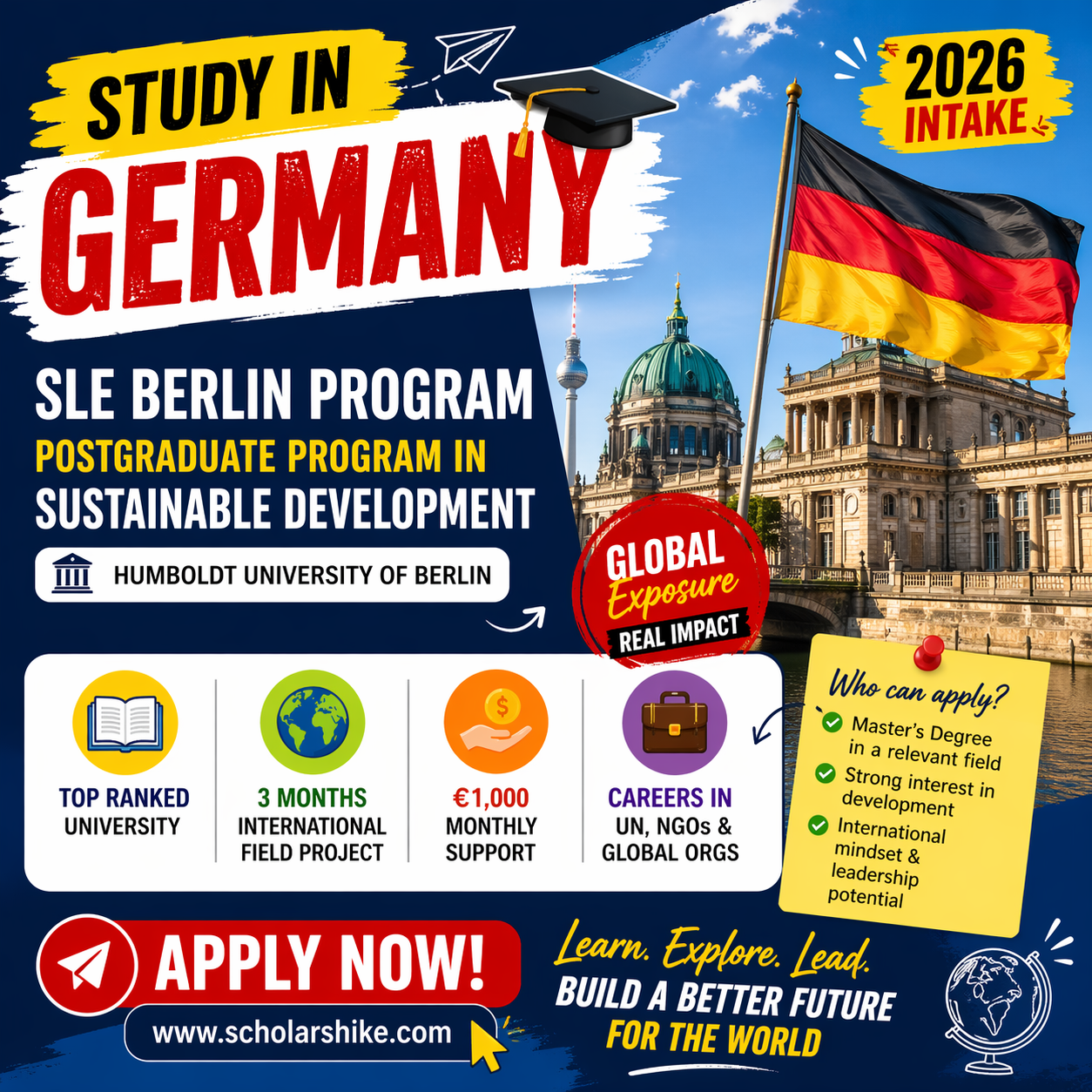
If you’re looking to build a career in global development or sustainability, Germany is likely already on your radar. But beyond the standard Master’s degrees, there is a specific, highly respected pathway at Humboldt University of Berlin that stands out: the SLE (Centre for Rural Development) postgraduate program.
Formally known as “International Cooperation for Sustainable Development,” this isn’t your typical sit-in-a-lecture-hall course. It’s a 12-month intensive program built for people who want to get their hands dirty with real-world fieldwork and research.
What makes SLE Berlin different?
Most academic programs talk about development challenges; SLE actually sends you to solve them. It bridges the gap between finishing your degree and landing a high-impact job. Instead of focusing on exams, you’ll spend your time working in teams on actual projects, preparing you for the fast-paced world of international NGOs and government agencies.
A Quick Look at the Program Structure
The year is split into four distinct phases that move you from the classroom to the field:
- The Berlin Phase: You’ll start with intensive modules on project management, policy, and sustainable development theory.
- The Prep Phase: You and your team will design a research framework for a specific assignment.
- Field Research (The Highlight): You’ll spend three months abroad conducting on-the-ground research in a developing country, working directly with local partners.
- The Wrap-up: You return to Berlin to finalize your findings and present your results to stakeholders.
Who can apply?
The program loves a mix of perspectives. They don’t just want policy students; they want a “brain trust” of different backgrounds. You’re a good fit if you have a Master’s degree in:
- Economics or Social Sciences
- Agriculture or Forestry
- Environmental Science
- Engineering or Politics
Requirements at a glance:
- Education: A completed Master’s degree.
- Language: High-level English (C1). German is a bonus but usually not a dealbreaker.
- Experience: They look for people who have already dipped their toes in the water through internships, volunteering, or relevant work experience.
Funding and Financial Support
Living in Berlin isn’t as expensive as London or Paris, but it still costs money. The SLE program offers a hybrid financial model to help:
- Monthly Stipend: You typically receive around €1,000/month.
- The Breakdown: 25% of the total funding is usually a non-repayable scholarship, while the rest is a manageable, low-interest loan.
- Family Support: There are often additional provisions if you are traveling with a spouse or children.
Career Outlook: Where do graduates go?
The SLE “stamp” on a resume is a big deal in the development world. Because of the heavy focus on fieldwork, graduates often bypass entry-level “internship loops” and move straight into roles at:
- The UN or specialized agencies (FAO, UNDP).
- GIZ (German International Cooperation).
- International NGOs like Welthungerhilfe or Oxfam.
- Government Ministries and policy think tanks.
Why Berlin?
Aside from the school, Berlin is a fantastic place to live. It’s a hub for international startups and activists, and it’s arguably the most “student-friendly” capital in Western Europe. You get a world-class education in a city that actually has a soul.
How to Apply
The selection process is competitive, so you’ll need to be organized. You’ll need your transcripts, a solid CV, and—most importantly—a motivation letter that explains why you care about sustainable development.
Pro Tip: Don’t just list your grades. Talk about the specific global challenges you want to tackle and how three months of field research will help you do that.
If you’re ready to move past the textbooks and start making an actual impact, the SLE program for 2026 is definitely worth the application effort.
Nabeel Akhter is an international education advocate and scholarship mentor dedicated to helping students access global academic opportunities. He studied in the United States at the University of Massachusetts Amherst through the Study of the U.S. Institutes (SUSI) for Student Leaders program funded by the U.S. Department of State.
Inspired by this journey, Nabeel now actively mentors and guides students in finding and applying for scholarships, exchange programs, and global learning opportunities, helping them navigate pathways to study and grow internationally.